Why automation keeps breaking in the spaces between systems
Infrastructure work does not usually break because one system is missing. It breaks in the handoffs. For cities, towns, utilities, and public works teams, service requests, work orders, field activity, assets, costs, plans, GIS, ERP, finance, and reporting all need to move together. But too often, they do not.
That messy operational space is the In-Between.
Spatial DNA helps local government and utility teams control the In-Between with workflow automation, data governance, validation, integration, and execution control.
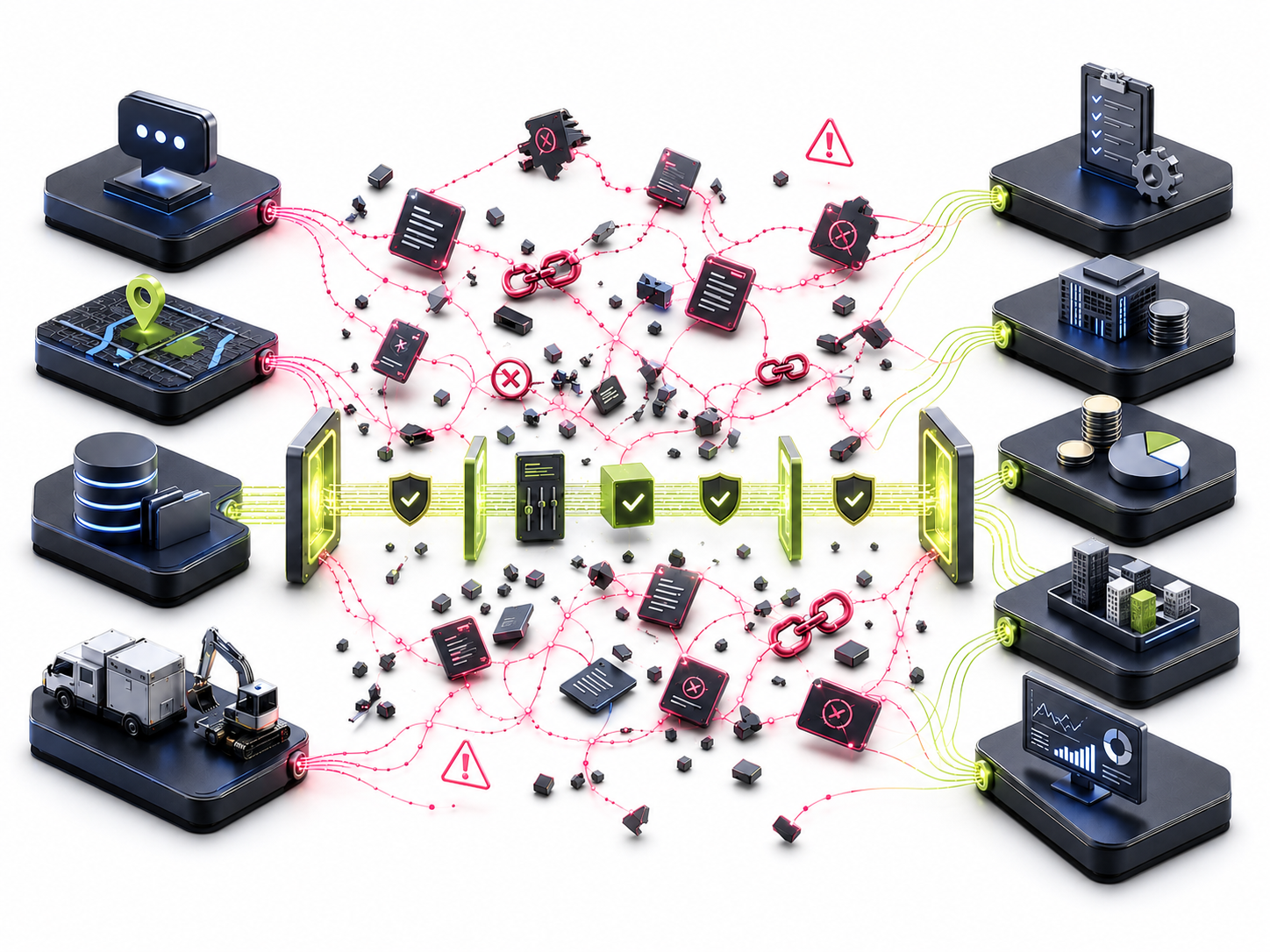
Automation is not the problem. Uncontrolled automation is.
Most organizations are not short on software. They already have systems for GIS, asset management, work management, finance, planning, inspections, customer requests, and reporting.
The challenge is that these systems do not automatically agree on what happened, what needs to happen next, who owns the next step, or whether the data is complete enough to move forward.
When automation is built around disconnected tools instead of controlled handoffs, the organization gets faster movement without better control.
The result is more exceptions, more reconciliation, more rework, and less trust in the data.
The 5 Dysfunctions of Automation
Handoff blindness
Work moves, but accountability gets lost.
A resident submits a service request. A work order is created. A crew completes field activity. An asset record changes. A cost needs to move into finance. A report needs to reflect the outcome.
On paper, the process looks connected. In reality, every handoff is a risk point.
When teams cannot clearly see where work is between systems, they lose the ability to manage the process as one operating model.
Common symptoms
GIS and asset records do not match
Crews collect field updates that never fully reconcile with core systems.
Finance codes, asset IDs, project IDs, or location references are inconsistent.
Reports require manual cleanup before they can be trusted.
Teams disagree about which system is the source of truth.
What good looks like
A governed data model where key records, IDs, locations, assets, costs, and statuses stay aligned across systems.
Data drift
Different systems describe the same reality in different ways.
GIS, asset systems, ERP, work management platforms, and reporting tools often contain overlapping records. They may describe the same asset, location, job, cost, or operational event, but not in the same format or with the same level of detail.
Over time, those small differences become operational risk.
The map says one thing. The work order says another. Finance sees a third version. Reporting becomes a debate instead of a decision tool.
Common symptoms
Teams do not know where a request, work order, or field update is stuck.Staff rely on email, chat, or spreadsheets to confirm what happened.
Supervisors must manually chase updates across departments.
Work appears complete in one system but incomplete in another.
Reporting lags reality.
What good looks like
A controlled workflow where every handoff is visible, accountable, and traceable from intake to execution to reporting.
Manual reconciliation
People become the integration layer.
When automation does not fully control the handoff, staff fill the gaps.
They copy data from one system into another. They fix exports. They compare spreadsheets. They update dashboards manually. They interpret missing fields. They correct records after the fact.
This work is often invisible, but it is expensive. It also makes operations dependent on institutional knowledge that is hard to scale and easy to lose.
Common symptoms
Required fields are missing or completed inconsistently.Invalid records move from field activity into asset, ERP, or reporting systems.
Errors are found after invoices, reports, or compliance outputs are produced.
Teams correct data manually at the end of the process.
Automation creates more cleanup instead of less.
What good looks like
Validation rules that stop, route, flag, or correct issues before they become downstream operational problems.
Validation gaps
Bad data moves too far before anyone catches it.
Automation can move information quickly. That is useful only if the information is complete, accurate, and ready to move.
When validation happens too late, problems travel downstream. Missing asset IDs, incomplete field updates, incorrect location references, invalid cost codes, and inconsistent statuses can all trigger rework later.
The issue is not just bad data. It is bad data moving without control.
Common symptoms
Staff maintain shadow spreadsheets to track work.Field data has to be cleaned before it can be used.
Month-end or project reporting requires manual reconciliation.
Teams re-key data between systems.
Process knowledge lives with specific people, not in the operating model.
What good looks like
Automated data movement with validation, exception handling, and clear ownership, so people manage the work instead of repairing the workflow.
No execution control
Automation runs, but no one can govern it end to end.
Many automation efforts begin as scripts, integrations, exports, scheduled jobs, or point-to-point connectors.
Those tools may solve a narrow problem, but they rarely provide enough control over the full operating process.
Without execution control, teams struggle to answer basic questions: What ran? What failed? What changed? What was skipped? Who approved it? What needs attention now?
Common symptoms
Integrations fail silently or require technical staff to investigate.Teams cannot easily audit what happened across the process.
Automation logic is scattered across tools, scripts, and vendors.
Exception handling is inconsistent.
There is no single control layer for operational execution.
What good looks like
A governed execution layer that monitors workflows, validates data, manages exceptions, records outcomes, and keeps the operating model under control.
The real issue is the In-Between
The 5 Dysfunctions show up in the spaces between the systems your organization already uses.
Between request and work order.
Between work order and field activity.
Between field activity and asset update.
Between asset update and GIS.
Between completed work and finance.
Between finance and reporting.
Between planning and execution.
This is where infrastructure operations often lose time, trust, and control.
Spatial DNA focuses on this In-Between.
We help teams connect the operational paths that need to move together:
Service requests
Work orders
Field activity
Assets
Costs
Plans
GIS
ERP
Finance
Reporting
The goal is not simply to automate more. The goal is to make automation controlled, governed, visible, and operationally useful.
How Spatial DNA helps control the In-Between
Workflow automation
We help define and automate the movement of work across people, systems, and departments, so handoffs are consistent and visible.
Data governance
We help align the records, IDs, fields, statuses, and business rules that determine whether systems can work together reliably.
Validation
We help catch incomplete, inconsistent, or invalid data before it moves downstream and creates operational or financial rework.
Integration
We help connect GIS, ERP, work management, asset systems, reporting tools, and other operational platforms around the process, not just the software.
Execution control
We help teams monitor what is happening, manage exceptions, record outcomes, and maintain operational control across the full workflow.
This page is for local government, utility, and public works teams that need to make infrastructure operations more connected, accountable, and reliable.
It is especially relevant for teams managing:
Service requests
Public works operations
Field crews
Asset management
GIS operations
Work order management
Capital planning
Maintenance planning
Utility operations
ERP and finance integration
Operational reporting
Compliance reporting
Signs your organization may have an automation dysfunction
You may be dealing with one or more of the 5 Dysfunctions if your teams are saying things like:
“We entered it in the system, but nobody knows what happened next.”
“The field team updated it, but finance does not have the right information.”
“The GIS record and the asset record do not match.”
“We still need the spreadsheet because the system does not show the whole picture.”
“The automation ran, but we do not know what failed.”
“Reporting takes too long because the data has to be cleaned first.”
“Everyone has a different version of the truth.”
These are not just technology issues. They are operating model issues.
From fragmented automation to controlled execution
The old model
Organizations often try to solve operational friction by adding another system, connector, dashboard, or script.
That may help temporarily, but it can also create another dependency, another handoff, and another place where context gets lost.
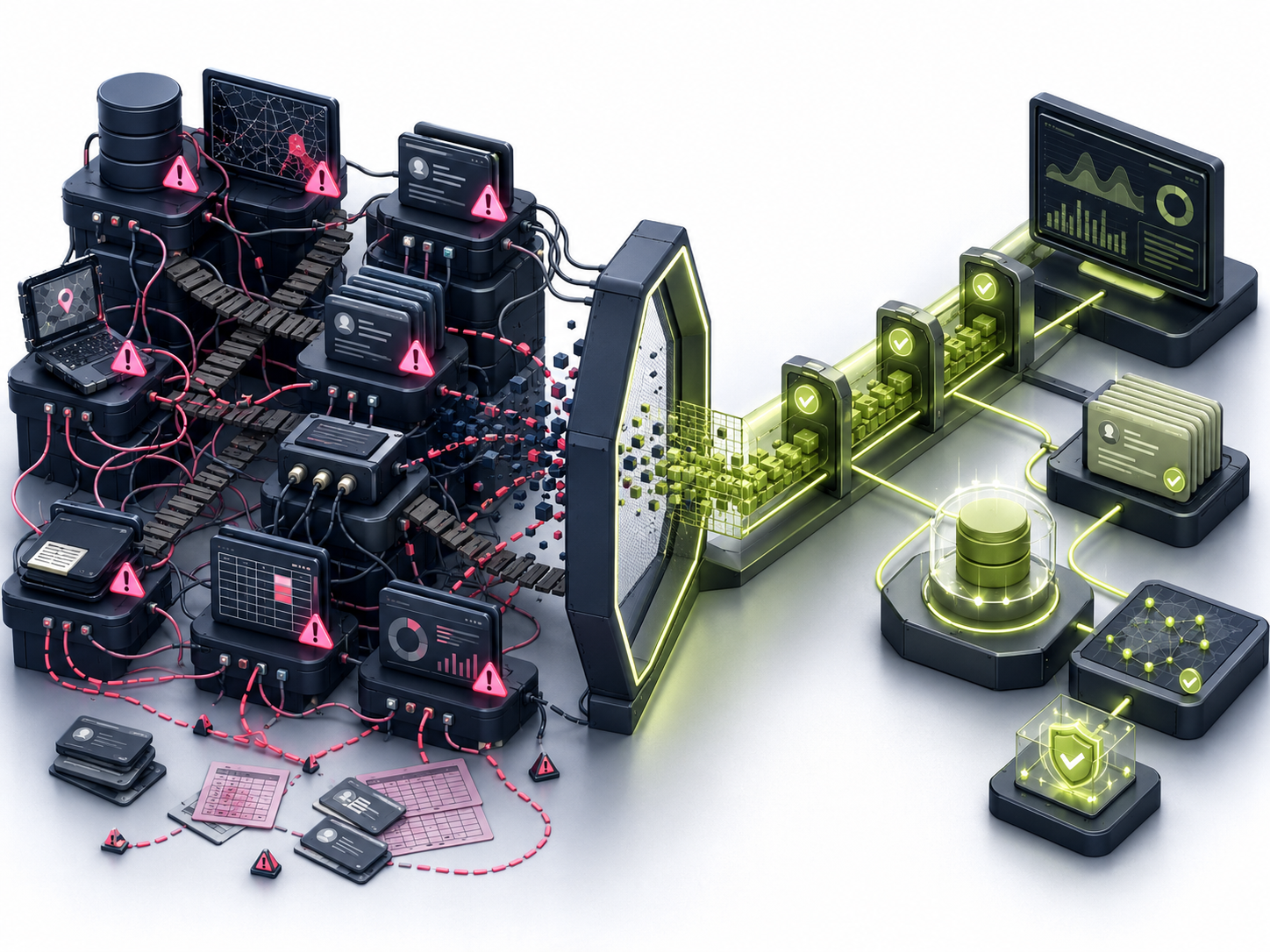
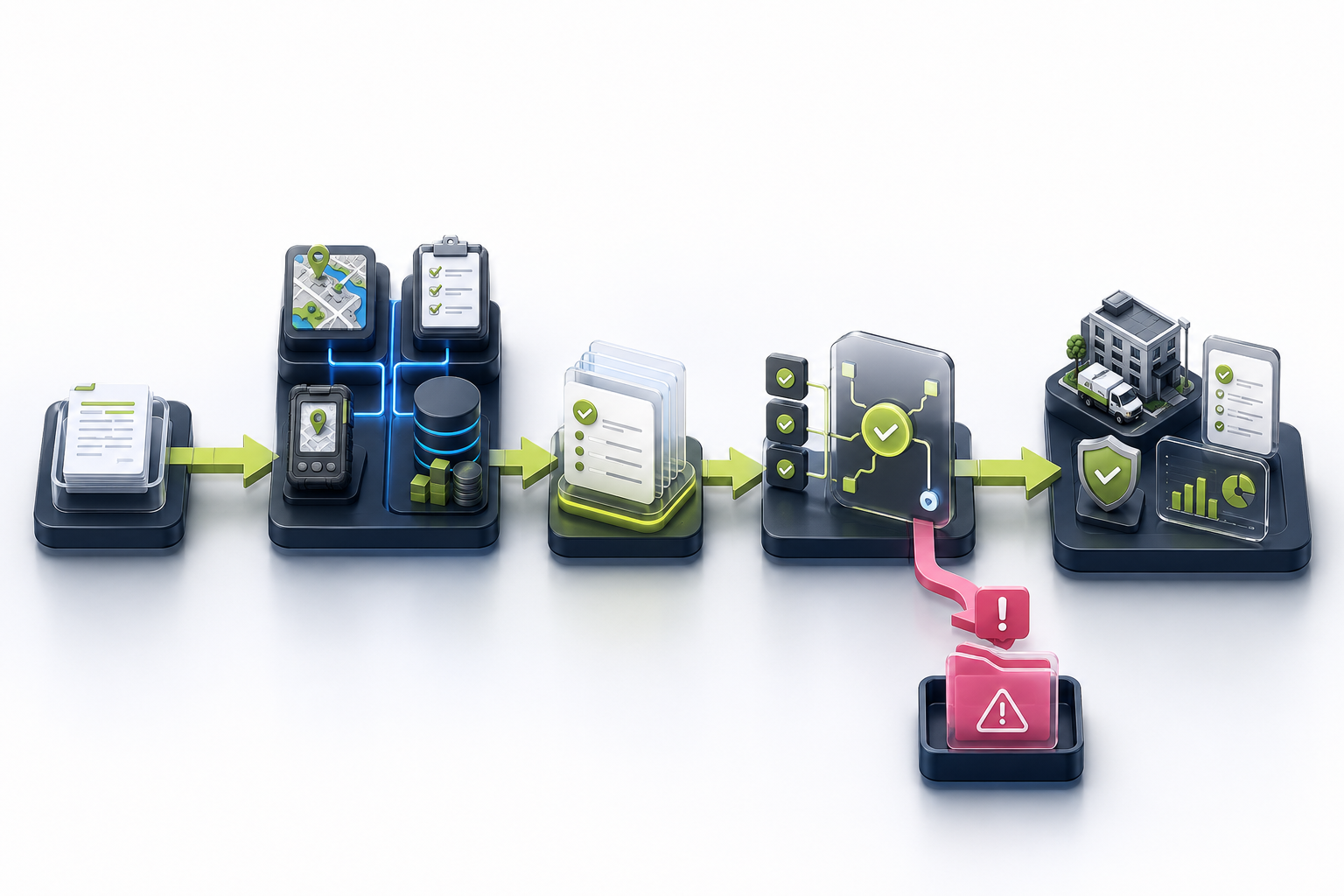
Spatial DNA starts with the operational flow.
What needs to move?
Which systems are involved?
Which data must be trusted?
Which rules determine whether work can move forward?
Which exceptions need to be managed?
Which outcomes need to be recorded?
Then we help design the control layer that lets automation work across the In-Between.
The 5 Dysfunctions of Automation are easiest to fix when you can see where they are showing up.
The Spatial DNA Automation Diagnostic helps identify where your workflows are losing control across systems, teams, and data handoffs.
Use it to assess:
- Where work is getting stuck
- Where data is drifting
- Where teams are reconciling manually
- Where validation is missing
- Where automation lacks execution control
Want to discuss your In-Between?
If your organization is trying to connect field work, assets, GIS, ERP, finance, and reporting, we can help you map the handoffs and identify where automation needs more control.
What are the 5 Dysfunctions of Automation?
The 5 Dysfunctions of Automation are recurring problems that cause automation to break down across operational handoffs. They are handoff blindness, data drift, manual reconciliation, validation gaps, and lack of execution control.
Why does automation fail in local government and utility operations?
Automation often fails because work has to move across multiple systems, teams, and data models. If the handoffs are not governed, validated, and monitored, automation can move bad or incomplete information faster without improving control.
What is the In-Between?
The In-Between is the operational space between systems, teams, and processes. It includes the handoffs between service requests, work orders, field activity, assets, plans, GIS, ERP, finance, and reporting.
How does Spatial DNA help?
Spatial DNA helps local government and utility teams control the In-Between through workflow automation, data governance, validation, integration, and execution control.
Is this only a technology problem?
No. The 5 Dysfunctions of Automation are operational problems that show up through technology. Fixing them requires aligning workflows, data rules, system integrations, ownership, and execution control.
Who is the Spatial DNA Platform for?
The platform is built for public infrastructure organizations, utilities, municipalities, airports, public works teams, and partners that need reliable integrations across operational, financial, spatial, and field systems.