Turn service requests into the right work.
Spatial DNA connects 311, CRM, customer service, GIS, work management and field teams so valid requests become correctly routed, context-rich and trackable work.
Keep the systems you already use. Control what happens between them.

The request was received. The work is still uncertain.
A request may enter through 311, CRM, a customer portal, an inspection, or an internal department. The operational response often happens somewhere else.
When that handoff is not controlled, requests are manually triaged, copied between systems, duplicated, misrouted, or sent to the field without enough context.
That creates:
- Manual routing and reassignment
- Duplicate or incomplete work orders
- Missing GIS and asset context
- Unclear ownership and priority
- Disconnected status updates
- Service reporting that needs explanation
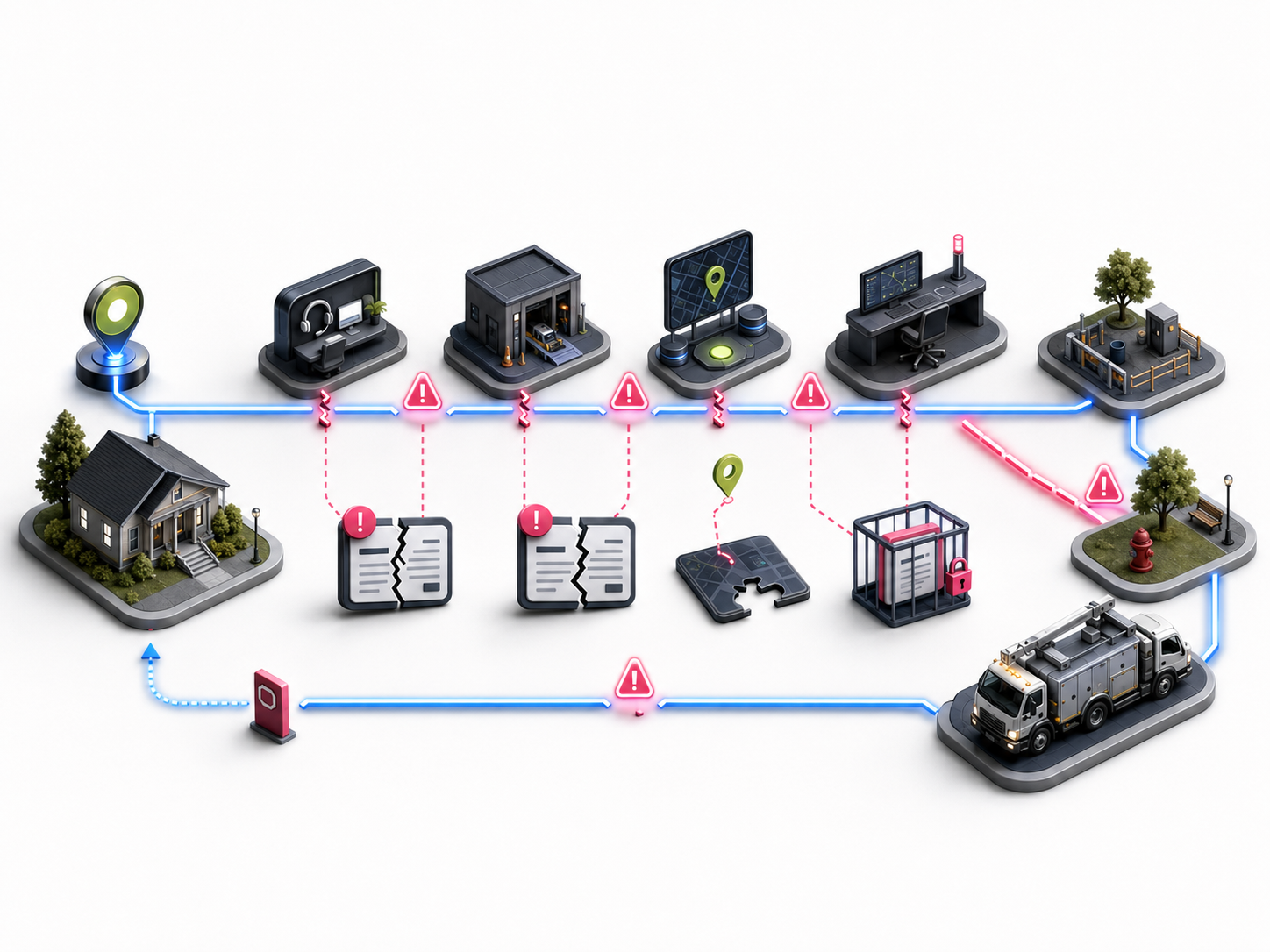
One controlled path from request to resolution.
Spatial DNA applies Execution Control across the Service to Work lifecycle.
It validates what is required, determines where work should go, preserves GIS and asset context, manages exceptions, and records what happened from request through resolution.
If a request is incomplete, duplicated, ambiguous, or incorrectly routed, the workflow can be held, reviewed, corrected and recovered before it becomes unnecessary work.
Your existing systems remain authoritative. Spatial DNA governs the handoffs between them.
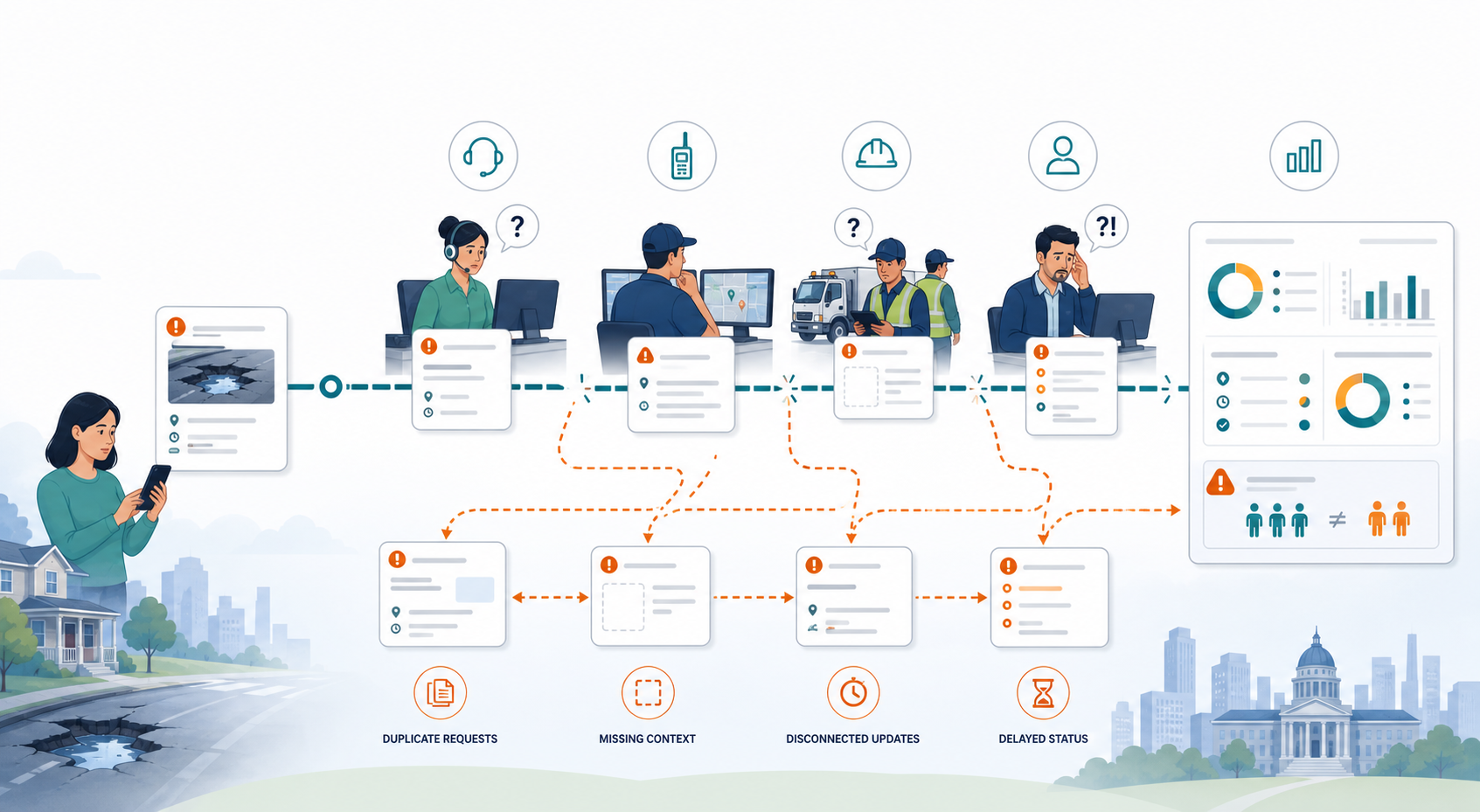
Where Service to Work usually starts.
Request to Work Order
Turn valid requests into complete, actionable work.
Validate required information and create the right work order with the correct location, asset, service type, priority and context.
Best for
-
Request validation
-
Work-order creation
-
Required field completion
-
Service type mapping
-
Duplicate prevention
311 / CRM to Public Works
Move requests from customer-facing systems into the platforms used to assign, execute and track work.
Best for
- 311 integration
- CRM to work management
- Customer service to public works
- Request status synchronization
- Cross-department handoffs
Routing + Triage
Apply rules for department, crew, service area, work type, asset, priority and escalation.
Best for
- Rules-based routing
- Priority assignment
- Department ownership
- Crew assignment
- Escalation management
Field + Asset Context
Carry location, GIS, asset, history, request details, attachments and priority into field execution.
Best for
- GIS enrichment
- Asset identification
- Location validation
- Work history
- Field-ready context
Closed-Loop Status
Return meaningful status and resolution updates to customer service, request systems, supervisors, reporting and leadership.
Best for
- Status synchronization
- Customer updates
- Resolution tracking
- SLA visibility
- Service reporting
Built for complex infrastructure handoffs.
Spatial DNA works in places where public service, infrastructure systems, operational data, geospatial context, field execution, and accountability meet.
Service to Work is not a generic ticketing story. It is about helping public-sector infrastructure teams bring discipline to the operational layer where requests become action.
This is especially important in local government and utility environments, where the same workflow may involve customer service, public works, utilities, IT, GIS, operations, finance, and leadership.
Spatial DNA helps teams move from disconnected service processes to governed, execution-ready work.
Start with one Service to Work workflow.
Bring one workflow where service requests enter, but the right work does not happen cleanly.
Spatial DNA can help your team map the handoff, identify where requests lose trust, define the rules, and create a practical path to control.
Good diagnostic candidates
- 311 request to work order
- CRM to public works
- Customer service to utility operations
- Resident request to field crew
- Request intake to asset lookup
- Service request to inspection
- Public works software to CMMS
- Work order status back to request system
One of the 5 Dysfunctions of Automation: no controlled handoff.
Automation does not fail only because systems are old. It often fails because the handoff was never defined.
Who owns the request?
Which system creates the work order?
What information is required before assignment?
Who decides priority?
What happens when the location is unclear?
When does the requester receive an update?
How does the organization know the work was truly resolved?
Service to Work breaks when these questions are left to habit, memory, or manual triage.
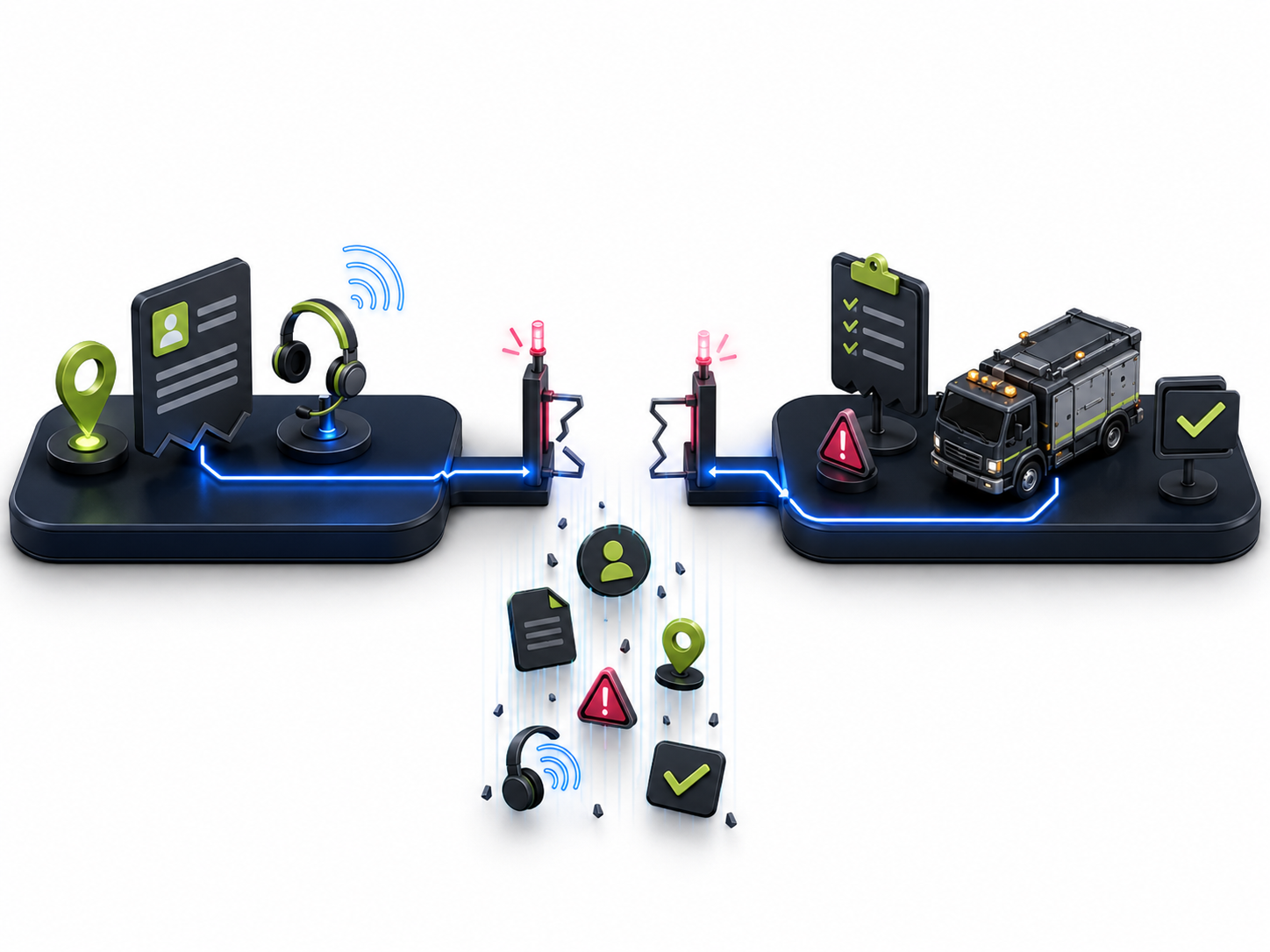
What is Service to Work?
Service to Work is the process of turning service requests, resident requests, customer issues, or internal requests into the right operational work through governed workflows, routing rules, work orders, field updates, and reporting.
Who is Service to Work for?
Service to Work is for cities, towns, utilities, public works departments, customer service teams, IT teams, GIS teams, operations leaders, and infrastructure organizations that need requests and work execution to align.
Does Spatial DNA replace 311, CRM, CMMS, or public works software?
No. Spatial DNA should be positioned as an execution control layer that connects, governs, validates, and controls the handoffs between existing systems such as 311, CRM, CMMS, GIS, ERP, work order management, and public works software.
What problems does Service to Work solve?
Service to Work helps reduce manual triage, duplicate work orders, disconnected request intake, missing field context, unclear ownership, inconsistent status updates, and reporting that teams do not fully trust.
Why does Service to Work matter for public works?
Public works teams need service requests to become clear, actionable work. When requests do not route correctly, field teams lose time, residents wait longer, and leadership has less confidence in service performance.
What systems are involved in Service to Work?
Typical systems include 311 platforms, CRM, resident request systems, work order management software, CMMS, GIS, asset management, ERP, public works software, field mobility tools, and reporting systems.
What is the first step?
The first step is to map one workflow where service requests do not become the right work. From there, teams can define routing rules, required data, system handoffs, ownership, and status update logic.
Ready to turn service requests into trusted work?
Start with the handoff that creates the most service noise.
Answer a few questions, identify the Service to Work gap, and get a clearer path from disconnected requests to trusted execution.