Choose where workflow control matters most.
Most workflow problems start in a handoff.
Field activity has to become a financial record. A service request has to become the right work. An approved plan has to become completed execution.
Different starting points. Same problem in between: keeping work, cost, assets, and decisions aligned as they move across systems.
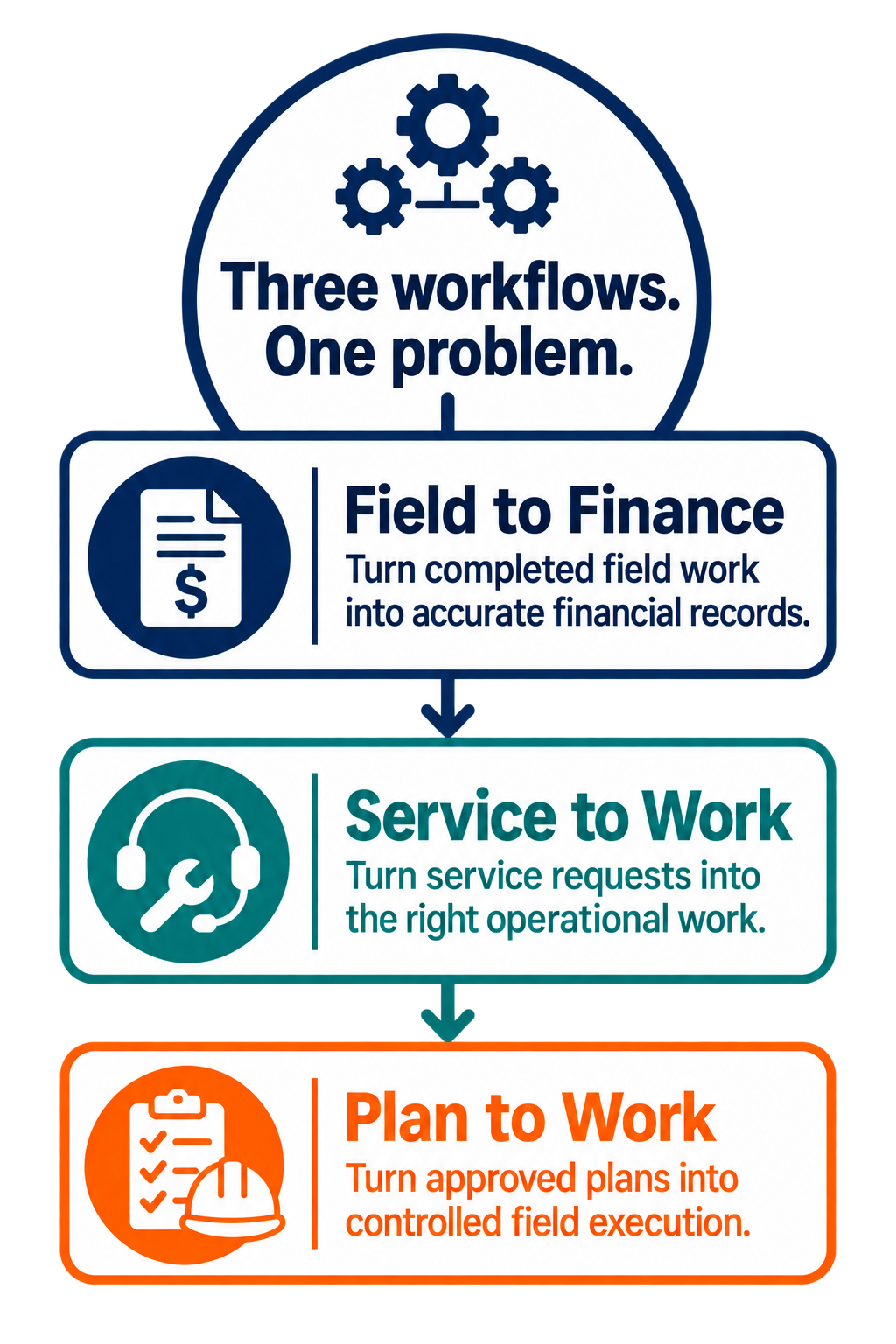
Three workflows. One problem.
Field to Finance
Turn completed field work into accurate financial records.
Service to Work
Turn service requests into the right operational work.
Plan to Work
Turn approved plans into controlled field execution.
Turn field activity into trusted financial records.
For teams that need work orders, labor, materials, inventory, payroll, ERP, finance, and reporting to agree.
Field to Finance helps completed work become validated cost, cleaner reconciliation, stronger audit trails, and financial records teams can defend.
Best for: work order costing, payroll alignment, inventory replenishment, AP and P-card cost capture, ERP and finance reconciliation.

Turn service requests into the right work.
For teams that need resident issues, customer requests, inspections, 311, CRM, work orders, GIS, field updates, and service reporting to stay connected.
Service to Work helps requests move from intake to action with the right routing, context, ownership, and status visibility.
Best for: 311 to work order, CRM to public works, request routing, field context, duplicate detection, service status updates.

Turn infrastructure plans into trusted execution.
For teams that need asset priorities, capital plans, budgets, projects, inspections, GIS, work orders, field execution, and costs to stay aligned.
Plan to Work helps approved priorities move into the right work, with clearer asset context, cost visibility, progress tracking, and outcome reporting.
Best for: capital plan to project, asset priority to work order, budget to actual cost, inspection to maintenance action, plan-versus-actual reporting

One operating pattern across every solution.
Each solution applies the same practical control model: understand the workflow, define the rules, and manage execution across the systems already in place.
Map
Map the systems, data, teams, decisions, dependencies, and exceptions behind the workflow.
Define
Define ownership, system authority, validation rules, workflow states, timing, and exception paths.
Control
Control execution with automation, validation, monitoring, APIs, exception handling, and a complete record of what happened.
This creates a practical path from disconnected processes to trusted operational outcomes without replacing every system the organization already uses.

Existing Systems
Built around the systems you already use.
Spatial DNA works across GIS, work management, ERP, finance, payroll, asset, and customer systems.
You keep your systems of record.
Spatial DNA controls the workflow between them.
Start with the workflow creating the most friction.
You do not need to redesign everything at once.
The Automation Diagnostic identifies where the workflow is breaking, which rules or ownership decisions are missing, and what needs to be controlled before automation can operate reliably.
What solutions does Spatial DNA offer?
Spatial DNA offers three packaged infrastructure solutions — Field to Finance, Service to Work, and Plan to Work — plus Aviation Data Operations for specialized aviation data needs.
What is Field to Finance?
Field to Finance helps teams turn field activity into trusted financial records across work orders, labor, materials, inventory, payroll, ERP, AP, P-card costs, and finance.
What is Service to Work?
Service to Work helps teams turn service requests, resident issues, inspections, and internal requests into reliable field execution.
What is Plan to Work?
Plan to Work helps teams connect capital plans, budgets, assets, municipal asset management software, GIS, finance, and completed field work.
What is Aviation Data Operations?
Aviation Data Operations helps teams convert, govern, validate, combine, and publish aviation data, including DAFIF, ARINC 424, AIXM, GIS aviation data, and AIRAC-cycle updates.
What is the Execution Control Layer?
The Execution Control Layer is Spatial DNA’s approach for controlling handoffs between systems, workflows, data, teams, and decisions using Map, Define, Validate, Execute, Monitor, and Improve.