Deliver controlled outcomes across connected systems
Spatial DNA helps partners deliver governed workflows across local government and utility systems without starting from scratch. Reusable specifications, controlled extensions, and execution evidence create a repeatable foundation for complex implementations
Complex projects break between the teams delivering them.
Municipal, local government, and utility automation projects often involve software vendors, implementation partners, internal IT teams, operational departments, and multiple systems of record.
Each party may understand its own system or responsibility. The risk appears in the In-Between, where requirements, decisions, data, approvals, and operational ownership must move from one team to another.

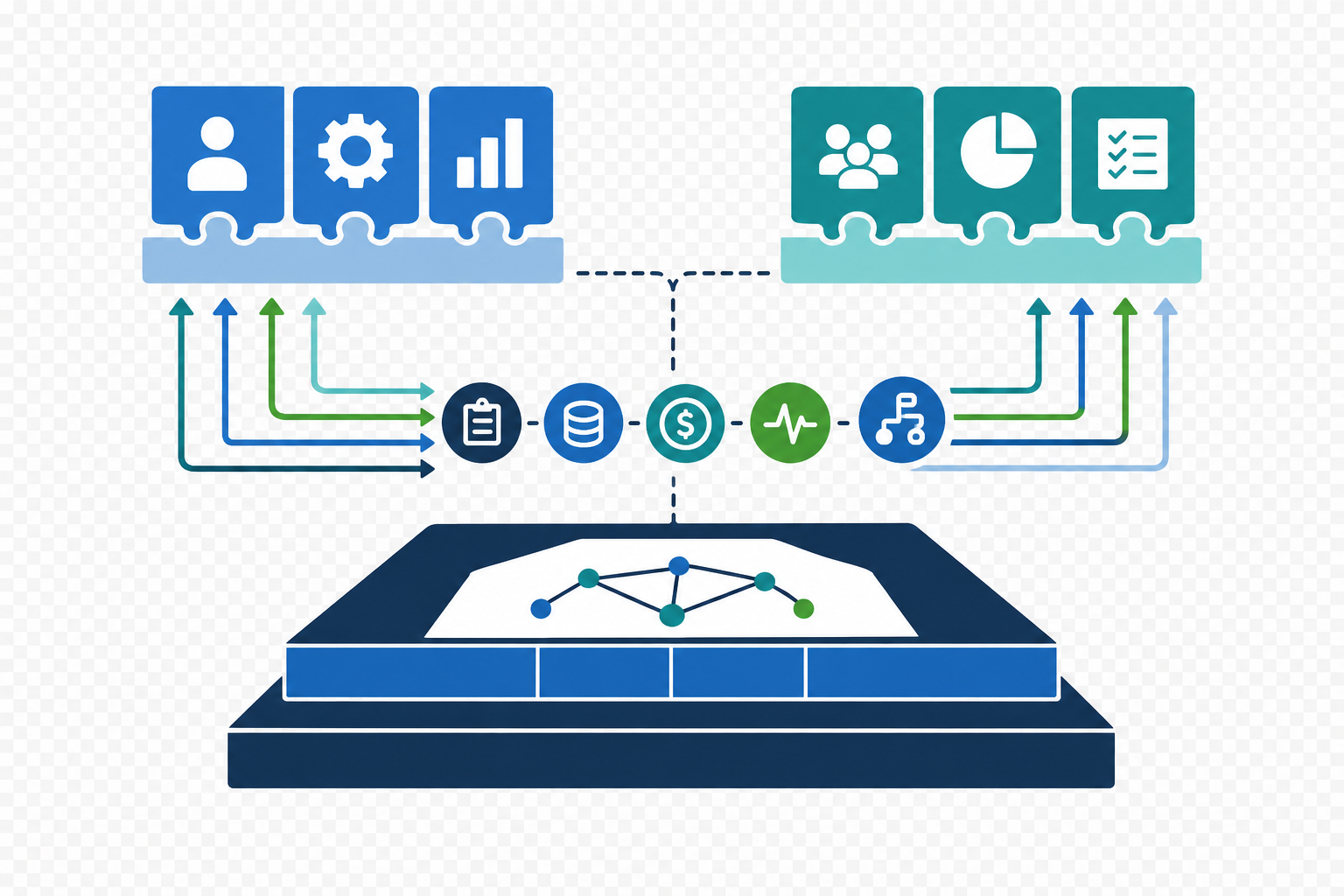
Give every partner a common foundation for execution
Spatial DNA separates the reusable platform foundation from partner expertise and customer-specific requirements. The platform governs how work, data, cost, status, and decisions move between systems while partners apply their industry knowledge and implementation experience to configure the right operational outcome.
Different partners. One controlled operating model.
Spatial DNA helps organizations combine platform capabilities, industry knowledge, implementation expertise, and customer context within one governed delivery approach.
Software and technology partners
Connect applications and product capabilities to governed municipal and utility workflows.
Systems integrators
Design and implement cross-system workflows without relying entirely on brittle point-to-point integrations.
Consulting partners
Turn operating models, process designs, and transformation strategies into controlled and traceable execution.
Implementation partners
Configure, test, deploy, and support customer workflows using repeatable platform patterns.
A repeatable path for delivering connected workflows.
Every engagement follows a controlled sequence that connects business requirements to operational execution.
Understand
Identify the customer’s systems, operating processes, priorities, constraints, and desired outcomes.
Map
Reveal where work, data, cost, status, and decisions move between systems and teams.
Define
Establish system authority, workflow states, interface contracts, business rules, approvals, exceptions, and ownership.
Configure
Apply reusable platform components, partner extensions, customer rules, mappings, and connectors.
Validate
Test the complete workflow across people, systems, data, policies, failure conditions, and operational scenarios.
Deploy
Release approved capabilities into the correct environment through a governed deployment process.
Operate and improve
Observe performance, investigate exceptions, refine workflows, and introduce controlled improvements over time.
The implementation may be collaborative. The delivery path remains controlled.
Protect the platform core while adapting to the customer.
Spatial DNA creates clear boundaries between reusable platform capabilities, partner-developed value, and customer-specific requirements.
Spatial DNA Core
The governed platform foundation.
- Execution Control Layer
- Spatial DNA Unified Model
- Specifications and interface contracts
- Workflow state and decision controls
- Security and access policies
- Execution evidence and observability
- Versioning and lifecycle management
Partner Extensions
Reusable partner capabilities.
- Industry-specific workflows
- System adapters and mappings
- Configuration packages
- Domain models
- Reports and applications
- Delivery accelerators
- Specialized services
Customer Rules
Requirements unique to the organization.
- System-of-record boundaries
- Approval structures
- Business policies
- Local terminology
- Data validation rules
- Security requirements
- Operational exceptions
Customer Systems and Outcomes
Controlled execution across ERP, GIS, finance, work management, asset management, field operations, customer systems, reporting, and AI.
Standardize what should be reusable. Extend what creates value. Configure what must remain local.
Every organization knows what it owns.
Partner delivery works when platform responsibility, implementation responsibility, and customer authority are clearly separated.
Spatial DNA owns the platform foundation
Spatial DNA provides and governs:
- Core platform capabilities
- Execution controls
- Unified models and specifications
- Platform security
- Versioning and lifecycle controls
- Operational evidence
- Platform reliability and support
The partner owns solution delivery
The delivery partner may provide:
- Discovery and solution design
- System and process expertise
- Workflow configuration
- Extensions and mappings
- Implementation services
- Testing coordination
- Training and change support
The customer owns operational authority
The customer defines and approves:
- Business priorities
- System ownership
- Data authority
- Security requirements
- Approval policies
- Operational acceptance
- Production decisions
Delivery teams share responsibility for success
Spatial DNA, the partner, and the customer collaborate on validation, release readiness, issue resolution, performance, and continuous improvement.
Clear ownership reduces ambiguity without limiting collaboration.
The controls partners need to build, extend, and support

Reusable specifications
Define reusable structures, behaviors, rules, and system interactions so foundational logic stays consistent across every customer implementation.

Governed extensions
Add customer-specific or industry-specific capabilities while preserving the reusable platform core, governance controls, and defined delivery boundaries.

Standard interface contracts
Define what each interface provides, who can use it, which rules apply, and how outcomes are returned.

Execution evidence
Trace requests, decisions, actions, retries, errors, and final outcomes across systems for complete operational transparency and accountability.
The project history does not disappear when implementation ends.
Spatial DNA records how workflows behave in production, including the requests received, rules evaluated, actions executed, systems involved, exceptions encountered, and outcomes produced.
This gives partners and customers a shared operational record for support, investigation, compliance, and continuous improvement.
Trace every workflow
Follow an operation from its original trigger through every decision, action, and response.
Investigate with context
See the workflow state, data, system interactions, rules, and error information connected to an issue.
Support across teams
Give platform, partner, customer, and system teams access to a common operational story.
Improve with evidence
Use actual execution history to identify recurring failures, delays, bottlenecks, and opportunities for automation.
Deliver the solution. Preserve the knowledge. Support the outcome.
Repeatable delivery without one-size-fits-all implementation.
Faster delivery
Start with reusable platform capabilities instead of rebuilding common controls for each project.
Lower implementation risk
Define authority, requirements, contracts, validation, and exception handling before production execution.
Less custom rework
Separate reusable logic from partner extensions and customer-specific rules.
Clearer accountability
Know which party owns the platform, implementation, operational decision, and final acceptance.
More supportable solutions
Preserve the evidence required to investigate behaviour across systems and organizations.
Scalable partner expertise
Turn specialized knowledge into repeatable workflows, specifications, extensions, and delivery patterns.
Greater customer confidence
Give customers a controlled and understandable path from implementation to long-term operation.
Stronger operational outcomes
Keep work, cost, status, data, and decisions aligned after the project goes live.
What is Spatial DNA Partner Delivery?
Spatial DNA Partner Delivery is a governed approach for designing, implementing, and supporting cross-system workflows with software vendors, consultants, systems integrators, and customer teams.
It combines the Spatial DNA platform foundation with partner expertise and customer-specific operational requirements.
Who can deliver solutions with Spatial DNA?
Spatial DNA can work with technology vendors, systems integrators, consulting firms, implementation teams, data specialists, application developers, and other organizations involved in municipal and utility transformation.
Does Spatial DNA replace the implementation partner?
No. Spatial DNA provides the governed platform foundation. Partners contribute system expertise, industry knowledge, solution design, configuration, implementation, and customer services.
Can partners build their own extensions?
Partners can create controlled extensions, mappings, workflows, reports, applications, and delivery packages while preserving the governed platform core.
How are customer-specific requirements handled?
Customer requirements are configured as governed rules, policies, mappings, approvals, and extensions. This allows the solution to adapt without turning every implementation into an entirely separate platform.
How does Spatial DNA make partner-built solutions supportable?
Spatial DNA records workflow execution, decisions, system interactions, retries, exceptions, versions, and outcomes. This evidence helps delivery teams understand and support the complete solution after deployment.
Which systems can partners connect?
Partner solutions can span the systems used in infrastructure operations, including GIS, ERP, finance, work management, CMMS, asset management, customer service, billing, field operations, planning, reporting, and approved AI applications.