Control what happens between your systems.
Your systems already know how to do their individual jobs.
The Spatial DNA Execution Control Layer governs the decisions, validation, timing, and exceptions that determine what happens as work moves between them.
Your systems remain the systems of record. Spatial DNA controls how they cooperate.
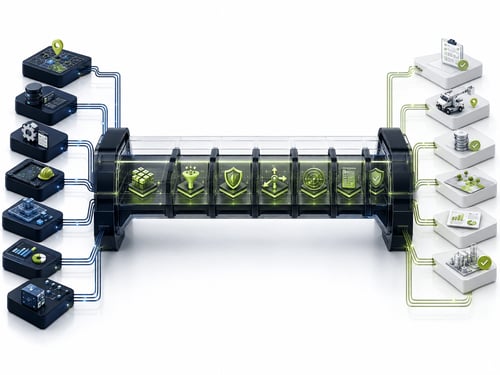
What is an Execution Control Layer?
An Execution Control Layer is the operational layer between systems that determines what should happen next, validates whether a workflow is ready to proceed, manages exceptions and recovery, and records the actions and decisions that produced the outcome.
It provides the control that is often missing between a successful technical connection and a trustworthy operational result.
Your systems remain the systems of record. Spatial DNA controls how they cooperate.

Existing systems
GIS, ERP, EAM, CMMS, finance, payroll, customer, planning, field, and reporting systems continue to perform their core responsibilities.
Execution Control Layer
Shared context, authority, workflow state, decision rules, validation, exceptions, recovery, and evidence are applied across the complete process.
Trusted outcomes
Correct work, complete cost, aligned assets, reliable status, and defensible reporting.
A connection can succeed while the outcome fails.
Technical movement is only one part of execution.
A record can arrive on time and still be incomplete, misrouted, out of sequence, or impossible to defend.
- The record moved, but required context was missing.
- The work order closed before all costs arrived.
- The service request routed to the wrong owner.
- The API returned success, but the downstream result could not be trusted.
When authority, state, timing, validation, exceptions, and evidence are managed separately, people still have to reconstruct the truth.
That uncontrolled operational space is the In-Between.
Spatial DNA brings it under control.
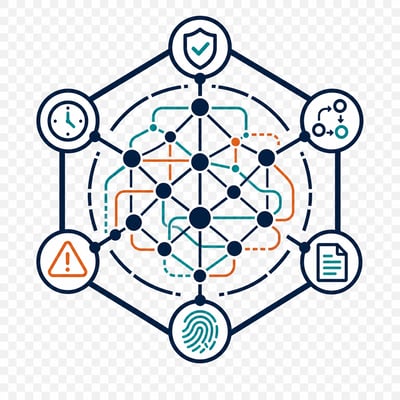
The In-Between is where execution loses control.
When handoffs are unmanaged, teams rely on spreadsheets, manual checks, local scripts, reconciliation, and institutional knowledge to keep work moving.
That may keep the process alive, but it does not make it governable.
Automation only moves the problem faster when authority, validation, ownership, and exception rules are unclear.
Spatial DNA brings the In-Between under control before it becomes delay, cost leakage, reporting doubt, and operational mistrust.
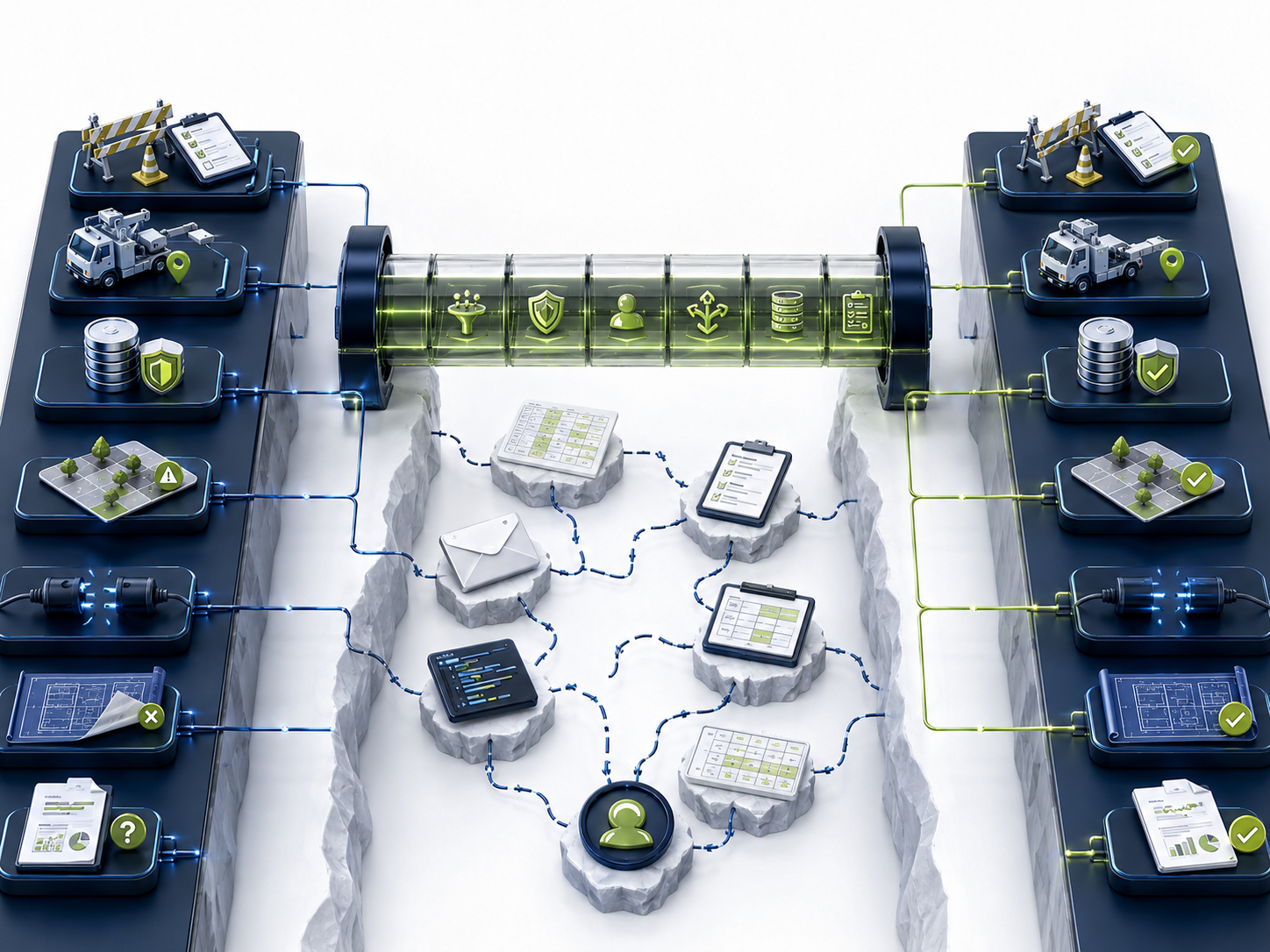
Built for the teams responsible for making systems agree.
The Execution Control Layer is designed for infrastructure organizations where work, data, systems, and decisions need to line up across departments.
Best-fit teams
Public Works
When service requests, work orders, field activity, crews, costs, assets, and reporting need to move as one controlled process.
Utilities
When inspections, maintenance, field work, customer requests, asset records, and financial handoffs need more governance.
IT and Systems Teams
When integrations, APIs, scripts, middleware, and connectors need to become more supportable, visible, and reusable.
GIS and Asset Teams
When asset IDs, locations, spatial data, work history, and operational records need to stay aligned.
Finance and Budget Teams
When operational work needs to become accurate cost, project, labour, material, and reporting data.
Operations Leaders
When leadership needs confidence that the process behind the report is controlled, not manually patched together.
What the Execution Control Layer makes possible.
Workflow orchestration
Define how work should move across systems, teams, rules, statuses, and decisions.
Data validation
Check required data, business rules, formats, status, ownership, and completeness before downstream systems rely on the record.
System handoff control
Govern when and how data moves between ERP, GIS, CMMS, finance, work management, asset systems, planning, and reporting tools.
Exception management
Identify incomplete, conflicting, late, or missing records before they become downstream reconciliation problems.
Visibility and traceability
Give teams a clearer view of what happened, where it happened, what changed, and which handoff needs attention.
Where the Execution Control Layer fits in the Spatial DNA platform.
The Execution Control Layer is the operational layer that makes the broader Spatial DNA platform practical.
It works with the platform’s supporting concepts and components:
Spatial DNA Unified Model / SUM
A shared model for how systems, assets, work, locations, costs, status, and decisions relate.
Specifications
Defined patterns for automation behavior, process logic, connectors, data flows, mappings, validation, and execution.
AI + APIs
Governed ways to connect systems and support AI-assisted use cases without losing control over data quality, ownership, or decision logic.
Partner Delivery
Diagnostic sessions, workflow mapping, integration planning, implementation support, and partner-led delivery models.
Solution Paths
Field to Finance, Service to Work, Plan to Work, and Aviation Data Operations each use the same deeper principle: control the handoff before the outcome breaks.
The Execution Control Layer is where platform architecture becomes operational control.
Map. Define. Control.
You do not need to replace every system to control execution. You need to govern what happens between them.
Map the handoff
Map the systems, workflows, data fields, teams, rules, exceptions, status changes, and decisions involved in the outcome.
What this reveals
Where work, cost, service, assets, location, ownership, and reporting lose alignment.
Define the rules
Define what must be true before data moves, work advances, status changes, exceptions escalate, or reports are trusted.
What this creates
A shared operating model for public works, utilities, IT, GIS, finance, planning, procurement, operations, partners, and leadership
Control execution
Use workflow automation, validation, APIs, specifications, monitoring, exception logic, and partner delivery to keep the handoff governed.
What this enables
Infrastructure work that moves across systems with less ambiguity, less reconciliation, and more trust.
Built for complex infrastructure handoffs
Spatial DNA works in places where public-sector operations, geospatial data, enterprise systems, finance, planning, field execution, APIs, and mission-critical data meet.
The Execution Control Layer is not a generic integration story. It is about helping infrastructure teams bring discipline to the operational layer where systems, workflows, data, and decisions depend on each other.
This is especially important in local government and utility environments, where the same workflow may involve public works, utilities, IT, GIS, finance, procurement, inventory, operations, planning, and leadership.
Spatial DNA helps teams move from connected systems to controlled execution.
From system movement to trusted execution.
When the Execution Control Layer is in place, teams spend less time explaining what happened and more time improving the outcome.
Before
- Integrations move data but do not govern the process
- Teams rely on spreadsheets and manual checks
- Exceptions are discovered too late
- Ownership is unclear when records conflict
- Reports require explanation before they can be trusted
- Automation depends on undocumented assumptions
- Every department maintains its own version of the truth
After
- Handoffs follow defined rules
- Required data is validated earlier
- Exceptions are easier to identify and route
- System authority is clearer
- Workflows are more visible
- Reports are easier to defend
- Teams can trust how work moved from one step to the next
The systems connect, the data is governed, and the work moves with control.
Start with one uncontrolled handoff.
Bring one workflow where systems are connected, but the outcome is still hard to trust.
Spatial DNA can help your team map the handoff, identify where execution loses control, define the rules, and create a practical path toward governed automation.
Good diagnostic candidates
- Service request to work order
- Work order to ERP
- Field work to finance
- GIS asset update to operational workflow
- Capital plan to work package
- Inventory usage to job cost
- Inspection to maintenance work
- Status update to reporting
- API handoff to downstream system
- Manual reconciliation to governed workflow
One of the 5 Dysfunctions of Automation: No controlled handoff.
Automation does not fail only because systems are old. It often fails because the handoff was never defined.
Who owns the record?
Which system is authoritative?
What data is required?
What should happen when something is missing?
When is the handoff complete?
Who approves exceptions?
How does the organization know the outcome can be trusted?
The Execution Control Layer exists to make those questions explicit before automation accelerates the wrong process.
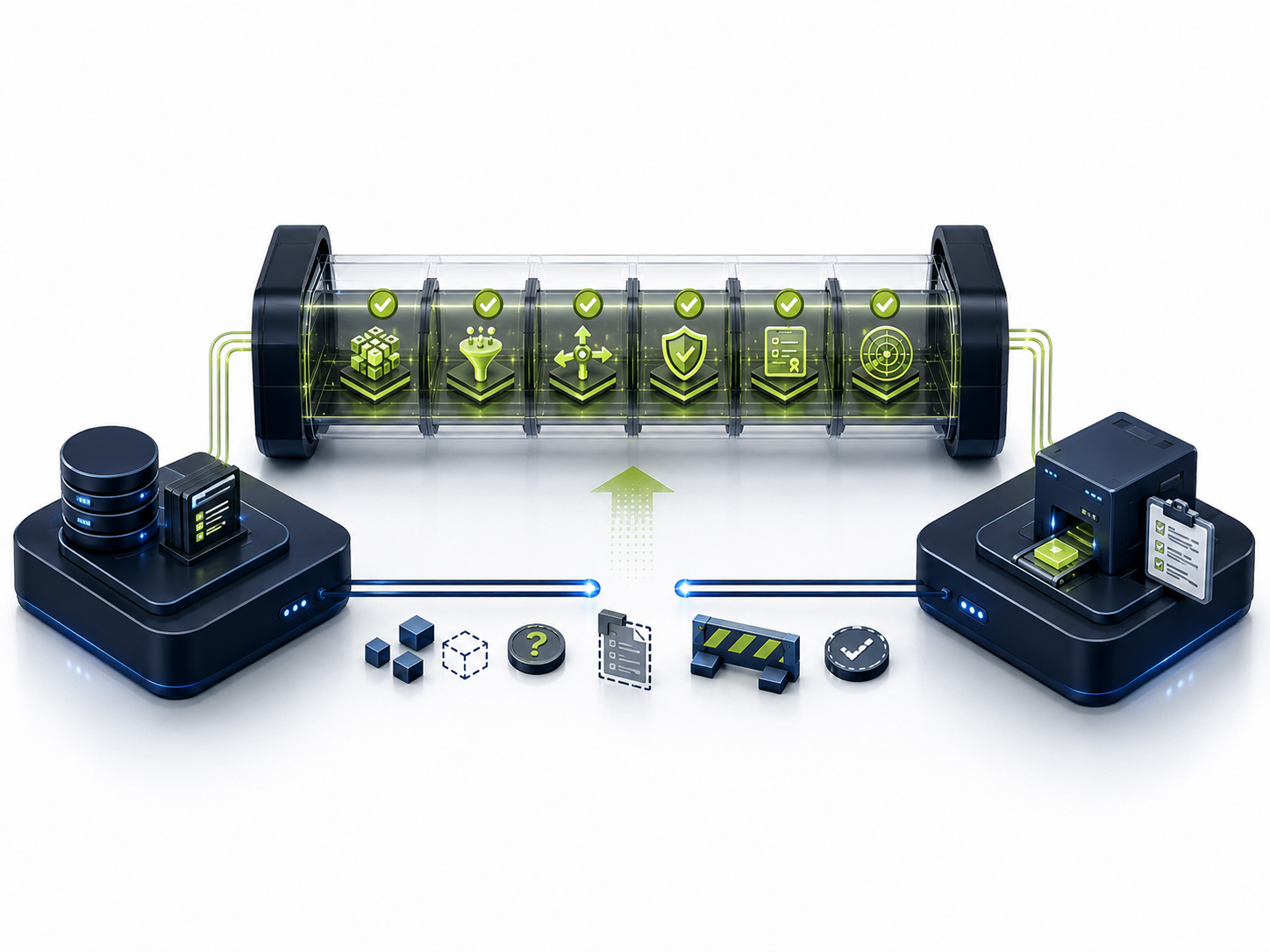
What is the Spatial DNA platformWhat is an execution control layer?
An execution control layer is the operational layer between systems that helps define workflow rules, validate data, govern handoffs, manage exceptions, and keep work aligned to trusted outcomes.
What does Spatial DNA’s Execution Control Layer do?
Spatial DNA’s Execution Control Layer helps infrastructure organizations control the handoffs between systems, data, workflows, APIs, teams, and decisions so work can move from disconnected processes to governed execution.
Who is the Execution Control Layer for?
It is for cities, towns, utilities, public works teams, IT teams, GIS teams, finance teams, planning teams, operations leaders, and infrastructure organizations that need existing systems to work together with more control.
What is an execution control layer?
An execution control layer is the operational layer between systems that helps define workflow rules, validate data, manage handoffs, track exceptions, and keep work aligned to outcomes.
Does the Execution Control Layer replace ERP, GIS, CMMS, or work order systems?
No. The Execution Control Layer should be positioned as a layer that connects, governs, validates, and controls the handoffs between existing systems such as ERP, GIS, CMMS, finance, asset management, work order management, planning, and reporting tools.
How is an execution control layer different from integration?
Integration moves data between systems. An execution control layer helps govern whether the right data moves at the right time, under the right rules, with the right validation, ownership, exception handling, and outcome visibility.
Why does local government need an execution control layer?
Local government teams often depend on multiple systems across public works, GIS, finance, IT, planning, assets, and operations. An execution control layer helps those teams reduce manual reconciliation, improve workflow trust, and create more reliable operational outcomes.
How does the Execution Control Layer support workflow automation?
It supports workflow automation by helping teams map handoffs, define rules, validate data, connect systems, monitor exceptions, and control how work moves across departments and systems.
What is the first step?
The first step is to map one handoff where systems are connected, but the outcome is still hard to trust. From there, teams can define rules, identify validation gaps, and create a path toward governed execution.
Ready to control the operational layer between your systems?
Start with the workflow that creates the most confusion, reconciliation, delay, or reporting doubt.
Start with the workflow that creates the most confusion, reconciliation, delay, or reporting doubt.