Secure by design and governed across every environment.
Spatial DNA protects the workflows, data, decisions, and system access that keep infrastructure operations moving. Deploy across managed cloud, customer-controlled, private, or hybrid environments without losing visibility, accountability, or operational control.
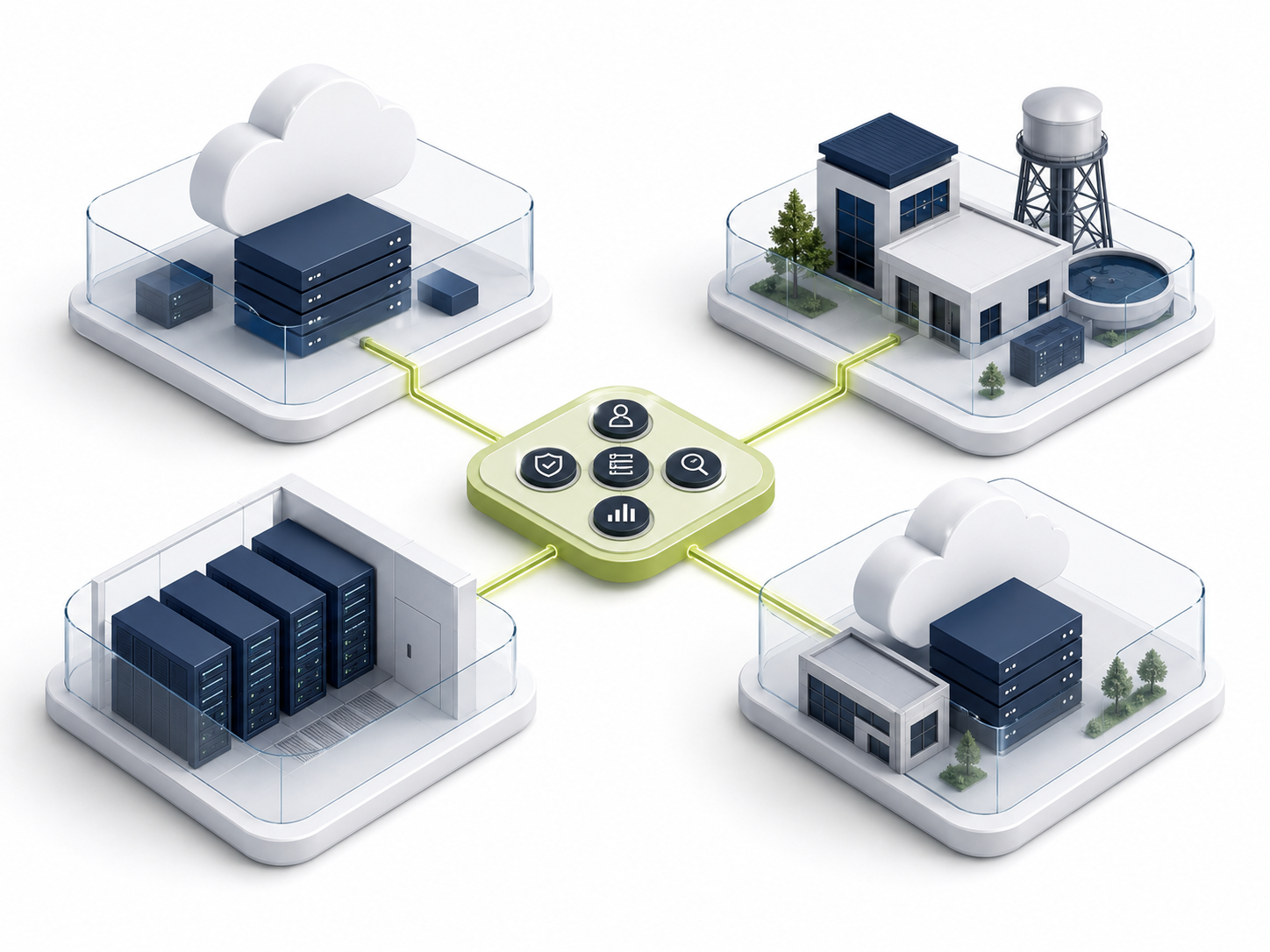
Govern every environment with one security model and the flexibility to deploy wherever operations require.
Security cannot stop at the system boundary.
Infrastructure workflows move across cloud platforms, internal networks, operational systems, APIs, databases, partners, and field applications. Each handoff introduces another identity, permission, credential, policy, and deployment dependency.
When these controls are managed separately, organizations lose visibility into who can act, what changed, which environment is running, and how an operational outcome was produced.
Inconsistent access
Users, systems, services, and partners often follow different authentication and permission models.
Environment drift
Development, testing, and production environments gradually stop behaving the same way.
Unmanaged credentials
Keys, tokens, certificates, and service accounts become difficult to rotate, monitor, and govern.
Limited evidence
Teams struggle to connect a release, access event, system action, or failure to the final operational outcome.
The issue is not only infrastructure security. It is maintaining control from access through execution.
Treat security and deployment as part of execution control.
Spatial DNA brings identity, authorization, environments, policies, releases, monitoring, and operational evidence into the same control model.
Security determines who or what is permitted to act. Deployment determines where approved capabilities can operate. Execution control ensures those actions remain governed from request to outcome.
Control access
Verify every person, system, service, partner, and AI agent before access is granted.
Control change
Manage platform changes through a repeatable lifecycle for versioning, validation, approval, and deployment.
Control execution
Apply policies, permissions, validation, and evidence throughout every workflow
Deploy where your operations require it.
Spatial DNA supports different deployment patterns while maintaining a consistent governance model across environments.
Managed cloud
Spatial DNA manages the platform environment, deployment lifecycle, monitoring, and platform operations.
Best suited for
Organizations seeking a managed and streamlined deployment model.
Customer-controlled cloud
Deploy within an approved customer cloud environment while retaining Spatial DNA platform controls.
Best suited for
Organizations with established cloud standards, subscriptions, or governance requirements.
Private environment
Run in a dedicated environment built for organizational isolation and security requirements.
Best suited for
Organizations managing protected systems, sensitive operational data, or strict infrastructure policies.
Hybrid deployment
Spatial DNA manages the platform environment, deployment lifecycle, monitoring, and platform operations.
Best suited for
Organizations seeking a managed and streamlined deployment model.
Secure connector deployment
Place controlled execution components closer to protected systems without exposing those systems directly.
Best suited for
Organizations that require secure access to internal applications, databases, or networks.
Environment separation
Maintain clear boundaries between development, testing, staging, and production.
Best suited for
Every organization that requires controlled releases and dependable production operations.
One control model across every layer.
Spatial DNA applies security throughout the platform, not as a separate layer added after deployment.
Identity and authentication
Verify users, services, systems, connectors, partners, and automated agents.
Authorization
Control which data, workflows, actions, interfaces, and environments each identity can access.
Network boundaries
Protect communication between users, the platform, connectors, and systems of record.
Secrets and credentials
Manage tokens, keys, passwords, certificates, and service credentials through controlled processes.
Data protection
Protect information while it moves, while it is stored, and while it is being processed.
Policy enforcement
Evaluate business, security, and operational rules before an action is permitted to execute.
Logging and evidence
Record access, decisions, changes, exceptions, releases, and operational outcomes.
Lifecycle management
Support access reviews, policy updates, credential rotation, versioning, deprecation, and controlled retirement.
Security follows the work from consumer to system of record.
Every request passes through a controlled path before it can interact with operational or financial systems.
Layer 1: Consumers
People, systems, partners, administrators, reporting tools, and AI agents request access or initiate actions.
Layer 2: Identity and access control
The platform verifies identity, permissions, policies, roles, and environment boundaries.
Layer 3: Spatial DNA Platform
Specifications, automations, the Spatial DNA Unified Model, execution rules, operational state, and evidence govern what should happen.
Layer 4: Secure execution boundary
Connectors, network controls, credentials, validation, retries, and deployment configuration control how actions are performed.
Layer 5: Systems of record
Approved actions reach operational, financial, GIS, asset, customer, planning, and reporting systems.
The platform controls who can act, what they can do, where it can happen, and how the outcome is recorded
Every release follows a controlled path.
Platform changes should not move into production through individual knowledge, undocumented steps, or one-time configuration. Spatial DNA supports a repeatable lifecycle from definition through operation.
Define
Document the required change, expected outcome, affected systems, dependencies, and environment requirements.
Build
Configure workflows, specifications, rules, interfaces, connectors, and deployment components.
Validate
Test permissions, data contracts, workflow behavior, failure handling, and downstream system interactions.
Approve
Confirm the change meets operational, technical, security, and release requirements.
Deploy
Release the approved version into the correct environment through a controlled process.
Observe
Monitor availability, behavior, performance, errors, retries, and downstream outcomes.
Recover and improve
Retry, roll back, correct, or update the deployment while preserving state and evidence.
Know what happened, why it happened, and what happens next.
Security and deployment controls are only dependable when teams can observe their behaviour. Spatial DNA connects platform activity to operational outcomes so administrators, delivery teams, and system owners can investigate issues without rebuilding the story manually.
Deployment evidence
Track versions, changes, approvals, release activity, environment state, and deployment outcomes.
Access evidence
Understand who or what accessed the platform, which permissions were used, and which actions followed.
Workflow evidence
Trace requests, decisions, system interactions, retries, exceptions, and final outcomes.
Platform health
Monitor availability, performance, latency, connector status, failures, and operational trends.
Controlled recovery
Preserve workflow state and accountability during retry, rollback, correction, or remediation.
Observe. Understand. Recover. Improve.
Secure operations without slowing execution.
A governed security and deployment model gives infrastructure organizations the control they need without creating more manual work around the platform.
Stronger operational protection
Protect access to critical workflows, data, systems, and platform capabilities.
Consistent environments
Reduce differences between development, testing, staging, and production.
Lower deployment risk
Use repeatable release patterns instead of undocumented or one-time processes.
Faster issue resolution
Connect errors and security events to the workflow, system interaction, and outcome that produced them.
Clear accountability
Trace access, approvals, configuration changes, releases, actions, and exceptions.
Resilient operations
Recover from failures without losing workflow state, history, or evidence.
Governed AI access
Allow AI agents to access approved capabilities without bypassing platform policies and controls.
Audit-ready evidence
Maintain the information needed to support operational reviews, compliance, and continuous improvement.
One security model. Flexible deployment. Every environment is governed.
Protect the systems that run your operations.
See how Spatial DNA can support your security, infrastructure, deployment, and operational control requirements across cloud, private, and hybrid environments.
Answer a few questions, identify the Plan to Work gap, and get a clearer path from disconnected plans to trusted execution.